-
Creating The Culture Shift Towards Inclusion with Constantijn van Oranje | Show notes on episode 70 of Women Disrupting Tech
How can we make inclusion something that we’re proud of? That question is the starting point for a special episode 70 of Women Disrupting Tech.
Constantijn van Oranje joins me to explore:
📈 Embracing differences between people as a strategic element in the growth of companies.
🧭 His personal journey, from role models to leadership strategies
🚀 Concrete steps tech companies of any size can take today to build more inclusive teams.Plus, you’ll learn how his late father and Neelie Kroes inspired him to explore the less conventional path. To listen, click play below or use the links throughout this blog post to listen on your favorite podcast platform.

Creating The Culture Shift Towards Inclusion with Constantijn van Oranje | Ep. 70 – Women Disrupting Tech
What we cover in this episode
- What we cover in this episode
- Timestamps
- The Magic you can expect in this episode 🪄
- Free ways to support the Women Disrupting Tech
- What makes this episode magical🌟?
- About Constantijn van Oranje and Techleap
- About Diverse Leaders in Tech
- Let me know what you think!
- What’s coming up?
- More episodes like this?
Timestamps
03:20 How Constantijn Became Special Envoy at Techleap
05:21 Organizing StartupFest with Airbnb, Uber, Google, and Apple CEOs
08:41 Concerns and Opportunities on AI in the Netherlands
10:44 His Leadership Role models
13:40 Neelie Kroes’ influence and the importance of diversity
16:07 Building an Inclusive Environment at Techleap
21:11 The importance of inclusive recruitment practices
24:30: Bringing your whole self to the office
30:03: How his father inspired him
34:21: Changes in gender equality in the Dutch Tech ecosystem
39:00: The need for more entrepreneurship education
46:07: The role of men as allies in promoting diversity
49:02: Creating a cultural shift towards more inclusion
The Magic you can expect in this episode 🪄
Will my podcast be obsolete by the end of 2032?
Probably not, if you ask Constantijn van Oranje, special envoy at Techleap.
He joins me on a special episode of Women Disrupting Tech to discuss a topic that’s near to his heart and crucial for the future of tech: making inclusion the new normal.
According to him, it requires a cultural shift in how we interact with each other, something that is “super hard to change.” It’s about changing the narrative: Inclusion isn’t a burden. It’s a key driver for better outcomes, teams, and lives.
Key highlights include:
- The influence of Neelie Kroes and his late father on his leadership approach.
- Why having diverse teams is a strategic element in the growth of companies.
- How small, targeted interventions can increase diversity awareness
- The need to promote entrepreneurship in education as a viable alternative to traditional employment.
Are you ready to dive in?
Free ways to support the Women Disrupting Tech
When you’re ready to support my guests in making this podcast obsolete by the end of 2032, help out by doing these two things:
- Use the share button to share the podcast with friends, family, and co-workers. This way, you give the women disrupting tech the platform they need to make it happen. Use the buttons below to share.
- Rate the podcast on your favorite podcast platform. Better yet, leave a review. You can use a rating of one to five stars. This will help other people discover the podcast. And if you leave a review, it will help me improve.
What makes this episode magical🌟?
Well, besides the fact that I interviewed a member of the Dutch Royal Family, it is probably Constantijn’s open attitude and his passion for DEI as a topic. Before the interview, I asked him about observing protocol, but he did not think that was needed. The result is an open and relaxed conversation.
Like when he talks about Neelie Kroes, his predecessor at what is now known as Techleap. We go in-depth about her leadership style, putting her ‘outside the box’ ideas into action, and changing her initial stance on quota.
Another thing that really struck me is that, as we recorded the episode on the birth date of his late father, he talked openly about how his father inspired him.
Quote from episode 70 of Women Disrupting Tech with Constantijn van Oranje, Special Envoy Techleap “We have to turn inclusion into something that we’re proud of.”
Constantijn van Oranje, Special Envoy at Techleap
About Constantijn van Oranje and Techleap
Constantijn van Oranje leads Techleap, the initiative to turn The Netherlands into a European powerhouse for tech companies. He and his team run programs and connect a community of the most promising and ambitious startup & scaleup founders in The Netherlands. Techleap also works with stakeholders like the government to improve the conditions for tech entrepreneurs to scale their companies.
Before Techleap, he was Chief of Staff to VP Neelie Kroes at the European Commission in charge of the Digital Agenda and led the Brussels office of the RAND Corporation following jobs at Booz Allen & Hamilton, IFC and the Cabinet of EC Commissioner Hans van den Broek.
In addition to innovation and technology, Constantijn van Oranje is passionate about art, music, photography, and nature.
You can follow Constantijn van Oranje and Techleap on LinkedIn. And you can learn more about Techleap’s programs on its website.
About Diverse Leaders in Tech
At the end of the episode. Constantijn also asks you to join Diverse Leaders in Tech, a request that I totally support (being a member myself). Diverse Leaders in Tech is a unique community that supports tech companies and leaders by creating benchmarks on diversity and inclusion. They also organize monthly meetings where you can learn about best practices in DEI. You can learn more on their website and by following them on LinkedIn.
Let me know what you think!
Please let me know your thoughts about this episode of Women Disrupting Tech in the comments.
I’m experimenting with letting the flow determine the conversation. I’m curious to hear if I managed to make this an engaging episode. So feel free to put your feedback in the comments.
And if you would like to suggest a guest that I absolutely must have on the podcast, send me an email or a DM on LinkedIn.
What’s coming up?
Next week, on Women Disrupting Tech, Sergio Panday joins me to talk about promoting ethnic diversity in corporate boardrooms and beyond.
After that, we return to women who are disrupting tech. In episode 72, Manisha Athukorala shares how corporate skills come in handy when you’re working for scaleups like Uber Eats, Sword Health and Mews.
So stay tuned for more inspiring women disrupting tech and their male allies in season three of Women Disrupting Tech!
More episodes like this?
It’s always difficult to compare, but if there are two episodes that I’d like you to listen to it’s these:
– In episode 31, Ingrid Tappin of Diverse Leaders in Tech and a front runner in DEI is my guest to share how she champions Diversity, Equity and Inclusion in tech.
– In episode 41 Sabine Schoorl shares how she uses curiosity to find exceptional impact and exceptional founders as a VC. -
Mastering Cultural Intelligence to Unlock Startup Success with Ma Cherie Cortez | Blog on episode 69 of Women Disrupting Tech

As a startup founder, you already know the importance of accessing top global talent to bring your solution to market and scale internationally. In fact, disrupting your industry and achieving success requires assembling the right team.
But how do you manage multicultural teams effectively?
And how can you leverage the diverse cultural differences within your workforce to enhance performance?
In this post, I’ll share insights from my conversation with Dr. Ma Cherie Cortez, a certified Cultural Intelligence (CQ) trainer and facilitator who has worked with global brands like Microsoft and SAP.
In Episode 69 of Women Disrupting Tech, we dive into the world of Cultural Intelligence (CQ) and explore its critical role in startup success. You can listen to the episode by clicking play below or look for “Women Disrupting Tech” in your favorite podcast app.
Mastering Cultural Intelligence to Unlock Startup Success with Ma Cherie Cortez | Ep. 69 – Women Disrupting Tech
Timestamps
04:10: The importance of Cultural Intelligence in managing international teams
12:40: Researching customs and practices
34:21: Defining Cultural Intelligence
36:56: The seven steps of cultivating Cultural Intelligence
43:20: Balancing cultural intelligence with staying true to yourself
47:30: The importance of cultural intelligence in remote and hybrid work environments
52:25: Enhancing conflict resolution and negotiation skills with CQ
55:55: The role of CQ in effective leadership
58:48: CQ as a key skill for startup founders
1:00:31: DEI in decision making
1:03:33: Using the agile framework to set goals for implementing CQ
1:06:26: The importance of learning the local language
1:15:02″ Continuous improvement and feedback when implementing CQ
What we cover in this episode
- Timestamps
- What we cover in this episode
- What makes this episode magical🌟?
- Free ways to support the Women Disrupting Tech
- About Dr. Ma Cherie Cortez
- What is Cultural Intelligence (CQ)?
- Why Cultural Intelligence is Critical for Startups
- CQ’s Role in Leadership, Conflict Resolution, and Decision-Making
- CQ and the Remote or Hybrid Work Environment
- Dr. Cortez’s Seven-Step Framework for Mastering CQ
- How to Implement CQ in Your Startup
- Continuous Improvement and Feedback
- Final Thoughts
- Listen to Episode 69 and Win a Free Book!
- Let me know what you think!
- What’s coming up?
What makes this episode magical🌟?
This episode is a Cultural Intelligence Masterclass. It starts with her own story of how she went from humble beginnings to getting a foot in the door at major brands like Microsoft and SAP, working as an IT expat, and ultimately working with companies and individuals as a certified CQ trainer and facilitator.
Ma Cherie shares so much knowledge and wisdom. It is clear that she lived the experience. Being an expat required her to become culturally intelligent and learn the customs and practices of other countries. Adapting to new circumstances became the key to her own success.
In that sense, there are many parallels to the life of startups and scale-ups. Every time you start out in a new country or move to a new phase, there are new things to explore and challenges to overcome. And cultural intelligence will help you make the best of it.
Free ways to support the Women Disrupting Tech
When you’re ready to support my guests in making this podcast obsolete by the end of 2032, help out by doing these two things:
- Use the share button to share the podcast with friends, family, and co-workers. This way, you give the women disrupting tech the platform they need to make it happen. Use the buttons below to share.
- Rate the podcast on your favorite podcast platform. Better yet, leave a review. You can use a rating of one to five stars. This will help other people discover the podcast. And if you leave a review, it will help me improve.
About Dr. Ma Cherie Cortez
Dr. Ma Cherie Cortez is a certified Cultural Intelligence Master Trainer and Facilitator. She was born in the Philippines and always dreamed of going abroad. Fortunately, she was a good learner. This helped her get out of poverty and into one of the best schools in the Philippines.
From there, she worked for international companies (including well-known brands like Microsoft, SAP, and InBev) for her entire career, most of it as an IT expat. So, she experienced the benefits of Cultural Intelligence firsthand.
As a master trainer and facilitator, she uses her own knowledge and experience to help people and companies improve their team performance and their bottom lines by becoming culturally intelligent.
She is also an award-winning author with three books in her name:
– 10X Expat Success (a free download on her website)
– Deliver Outside The Box
– Mastering Cultural Intelligence in 7 Steps.You can find more information about Ma Cherie, her services, and her books on her website. Of course, you can also connect with her on LinkedIn and follow her on Instagram.
What is Cultural Intelligence (CQ)?
Cultural Intelligence (CQ) is the ability to relate to and work effectively with people from different cultural backgrounds. While IQ measures cognitive ability, CQ measures how well you navigate cultural differences.
As Dr. Cortez explains:
“CQ is about more than understanding customs; it’s about adapting your behavior to different environments while staying true to yourself.”
Mastering CQ is essential for founders looking to build high-performing, diverse teams, particularly when scaling globally.
Why Cultural Intelligence is Critical for Startups
For startup founders, CQ is an essential skill that can make or break your success. Here’s why:
– Global Talent Management: As you scale, you’ll attract top talent from across the world. To manage those diverse teams effectively, you need to understand cultural nuances and foster a collaborative environment.
– Diversity, Equity, and Inclusion (DEI): Prioritizing DEI is not just a trend; it’s a driver for innovation and success. Founders with high CQ can use diversity as an asset, enabling their teams to thrive and innovate.
– Authenticity and Adaptability: Founders often struggle with balancing authenticity and adaptability. Dr. Cortez’s seven-step framework helps you navigate this, ensuring you stay true to your values while successfully leading multicultural teams.
Quote from episode 69 of Women Disrupting Tech with Dr. Ma Cherie Cortez “To be successful, startup founders need to have cultural intelligence as a tool in their toolbox.”
Dr. Ma Cherie Cortez
CQ’s Role in Leadership, Conflict Resolution, and Decision-Making
Cultural Intelligence is also crucial when it comes to leadership. Whether you’re resolving conflicts, negotiating deals, or making decisions, CQ helps you approach these tasks with a global mindset. In diverse teams, misunderstandings and conflicts can arise, and effective leaders know how to navigate these situations by recognizing cultural differences.
By incorporating CQ into your leadership, you will enhance your ability to manage conflicts, build trust, and make decisions that consider the cultural contexts of your team members.
“Without being culturally aware, it makes it more difficult to communicate and be productive,” says Dr. Cortez, especially in remote and hybrid work environments.
CQ and the Remote or Hybrid Work Environment
In today’s world, remote and hybrid teams are the norm for many startups. Dr. Cortez emphasizes that Cultural Intelligence is vital in this context. Miscommunication and misunderstandings can occur easily when teams span across different countries, time zones, and cultural backgrounds.
Leaders with high CQ can build trust, foster effective communication, and keep remote teams engaged, helping the company preserve productivity despite geographic differences.
Dr. Cortez’s Seven-Step Framework for Mastering CQ
In Episode 69, Dr. Cortez shares her seven-step framework for developing Cultural Intelligence, a guide that startup founders can implement:
- Personal Mastery: Develop a drive to learn about different cultures and integrate that knowledge into your behavior.
- Intercultural Competence: Build cultural sensitivity and awareness, recognizing the subtle differences that impact team dynamics.
- Relational Synergy: Foster collaboration by bridging cultural gaps and creating harmonious working relationships.
- Inclusive Leadership: Lead diverse teams to success by creating an environment where every voice is valued and heard.
- Advocacy and Impact: Use your cultural intelligence to make a meaningful difference in your organization and beyond.
- Mastery and Growth: Continuously set self-development goals and adopt a growth mindset.
- Reflection and Refinement: Cultural Intelligence is not static; it requires constant reflection, feedback, and improvement.
This framework provides a step-by-step approach to mastering CQ, ensuring that you stay adaptable, empathetic, and effective in your leadership.
How to Implement CQ in Your Startup
To bring Cultural Intelligence into your startup, Dr. Cortez suggests setting clear, actionable goals using the agile framework. This method helps you implement CQ gradually while tracking progress. Another key aspect is learning the local language of your teams. Even if just a few phrases, it goes a long way in building rapport and respect.
Continuous Improvement and Feedback
Developing CQ is a continuous process. Dr. Cortez highlights the importance of feedback and self-reflection to refine your approach over time. By being open to learning and adapting, you’ll ensure that your team remains cohesive and successful in the long run.
Final Thoughts
Cultural Intelligence is more than just a buzzword. For startup founders, it’s a critical skill that enables you to lead diverse teams, scale globally, and stay competitive. By mastering CQ, you can navigate the complexities of cultural differences while remaining authentic and adaptable.
Whether you’re managing remote teams, resolving conflicts, or expanding into new markets, CQ is the key to unlocking startup success. Don’t miss the chance to learn from Dr. Cortez and get practical insights on how to elevate your leadership game.
Listen to Episode 69 and Win a Free Book!
Ready to dive deeper into Cultural Intelligence and learn how to apply it to your startup? Listen to Episode 69 of Women Disrupting Tech on Spotify, Apple, or YouTube.
Plus, the first five listeners to email me at dirkjan@womendisruptingtech.blog will receive a free copy of Dr. Cortez’s book—a resource valued at thousands of euros!
Let me know what you think!
Please let me know your thoughts about this episode of Women Disrupting Tech in the comments.
This blog is an experiment to see what happens if I include more information. Please let me know what you think about it.
If you believe this blog and podcast have been relevant to you as an entrepreneur, would you do me a favor and share them with friends, family, and co-workers? This way you give Ma Cherie and the other Women Disrupting Tech a platform to increase diversity in tech.
PS. If you would like to suggest a guest that I absolutely must have on the podcast, send me an email or a DM on LinkedIn.
What’s coming up?
Next week, on Women Disrupting Tech, I will have a guest who has been at the top of my “people to interview” list since the beginning of the show. Constantijn van Oranje will be my guest to talk about how to be a royal ally for Women Disrupting Tech.
He’s followed by a man who does not want to be called an ally. Sergio Panday joins me to talk about promoting ethnic diversity in corporate boardrooms and beyond.
So stay tuned for more inspiring women disrupting tech and their male allies in season three of Women Disrupting Tech!
-
Lieke Beelen on Making Legalese Easy to Understand with Visual Contracts | Show notes on episode 68 of Women Disrupting Tech

“Legalese” is the complex language lawyers use, making even the simplest agreements feel overwhelming.
Lieke Beelen set out to change that. With her startup, Visual Contracts, she aims to make legal documents more accessible through visual design, breaking down barriers to justice.
In episode 68, Lieke is my guest to talk about
⚖️ Building the “Canva for Contracts”
👩🏻💻 The importance of finding the right people to help you
😢 Dealing with the rejection and failure that is part of a startup founder’s lifePlus, she shares why she decided to take a break from her startup and the lessons she learned along the way.
Lieke Beelen on Making Legalese Easy to Understand with Visual Contracts | Ep. 68 – Women Disrupting Tech
What we cover in this episode
- What we cover in this episode
- The Magic you can expect in this episode 🪄
- Free ways to support the Women Disrupting Tech
- What makes this episode magical🌟?
- About Lieke Beelen and Visual Contracts
- Let me know what you think!
- What’s coming up?
- More episodes like this?
The Magic you can expect in this episode 🪄
So far, I’ve interviewed women who are building a career, a product or a company. But what happens if you need to take a break? That is what this episode is about.
In episode 68 of Women Disrupting Tech, I sit down with Lieke Beelen. Until recently, she was working on her big vision: simplifying legal contracts to make them more accessible and understandable. Think of it as the “Canva for Contracts.”
But trying to innovate in such a conservative industry isn’t easy, especially when investors don’t quite get what “design” can do in a legal tech context.
Lieke also opens up about the challenges of being a neuro-divergent founder, how she struggled to gain traction and the mental toll it all took.
In the end, her story isn’t over. It is just on pause. Waiting for new energy to make legalese easy to read with Visual Contracts.
Free ways to support the Women Disrupting Tech
When you’re ready to support my guests in making this podcast obsolete by the end of 2032, help out by doing these two things:
- Use the share button to share the podcast with friends, family, and co-workers. This way, you give the women disrupting tech the platform they need to make it happen. Use the buttons below to share.
- Rate the podcast on your favorite podcast platform. Better yet, leave a review. You can use a rating of one to five stars. This will help other people discover the podcast. And if you leave a review, it will help me improve.
What makes this episode magical🌟?
The magic of this episode is in the second part of the conversation when Lieke opens up about her struggles. The result is a vulnerable conversation about managing energy, adapting to the world, and her decision to take a break from Visual Contracts.
Lieke also highlights how essential it is for running a successful business to have alignment with your co-founder and what she has learned from having to end the relationship with the previous one.
And if you think the legal world is into great design, you want to listen to Lieke explaining the curse of the word design in a legal context.

Quote from episode 68 of Women Disrupting Tech with Lieke Beelen. Picture credit: Suzan Alberts, https://suzanalberts.com/ “The diversity and inclusion part … that has always been the driver.”
Lieke Beelen, Founder of Visual Contracts
About Lieke Beelen and Visual Contracts
Lieke Beelen is the founder of Visual Contracts. She used her background in Industrial Design Engineering to build a platform that businesses can use to make their contracts easy to understand for ordinary human beings like you and me.
You can connect with her and follow her journey on LinkedIn. And if you’d like to learn more about Visual Contracts, feel free to visit the website or the LinkedIn page. Lieke also set up a Visual Contracts Community on LinkedIn that you can join.
Let me know what you think!
Please let me know your thoughts about this episode of Women Disrupting Tech in the comments.
I’m experimenting with letting the flow determine the conversation. The purpose is to see if I can connect with guests on a deeper level than I’ve done so far. So feel free to tell me if that made for a good episode.
And if you would like to suggest a guest that I absolutely must have on the podcast, send me an email or a DM on LinkedIn.
What’s coming up?
Next week on Women Disrupting Tech, we learn from Dr. Ma Cherie Cortez how to master cultural intelligence in seven steps.
After that, I will have a guest who has been at the top of my “people to interview” list since the beginning of the show. I will not yet reveal who it is, but I promise you that it’s going to be special.
So stay tuned for more inspiring women disrupting tech and their male allies in season three of Women Disrupting Tech!
More episodes like this?
This episode is quite difficult to compare because we’re discussing personal feelings. That said, there are a couple of quite special conversations that I think you’ll enjoy.
– In episode 4, Faviola Dadis shares how she was dealing with personal health issues.
– In episode 9, Marie Weijler shares a bit about her work-life balance.
– In episode 18, Lotte Leufkens talks about what being an elite bridge player does to your popularity at school.The last two episodes are in Dutch and are in the top 10 of most listened-to episodes.
-
How to Inspire the Next Generation of Women in Tech with Mitra Gilasgar | Show Notes to Episode 67 of Women Disrupting Tech

In Episode 67 of Women Disrupting Tech, Mitra Gilasgar shares her inspiring journey into tech, from navigating the male-dominated environments of academia and corporate settings to becoming a role model for women at Role It Out.
She talks about her experiences as one of the few female engineers in a male-dominated company and reveals what it took for her to pave her own path in the industry.
Tune in for an honest, inspiring conversation on how role models can inspire the next generation of women in tech.
To listen, click play below or find episode 67 of Women Disrupting Tech on your favorite podcast platform.
How to Inspire the Next Generation of Women in Tech with Mitra Gilasgar | Ep. 67 – Women Disrupting Tech
What we cover on this blogpost
- What we cover on this blogpost
- The Magic You Can Expect in this Episode 🪄
- Free ways to support the Women Disrupting Tech
- What makes this episode magical🌟?
- About Mitra Gilasgar
- About Role It Out
- Let me know what you think!
- What’s coming up?
- More episodes like this?
The Magic You Can Expect in this Episode 🪄
How can we inspire more women to pursue a career in tech?
One thing is clear: Role models play a huge part.
That’s why I’m chatting with Mitra Gilasgar about how we can inspire the next generation of women in tech.
Some highlights from our conversation:
💡 Mitra’s mother is her role model, showing her that it is possible to be a woman in STEM.
💡 Her transition from academia to corporate life changed her perspective on women in tech in more ways than one.
💡 Mitra’s determination to be a role model who inspires the next generation in tech.We also dive into something that not everyone agrees on—Mitra’s take on women saying it’s OK to be the only female in tech spaces and that we shouldn’t force women into the field.
Ready to be inspired? Tune into the episode on Spotify, Apple, or YouTube.
PS. Don’t forget to let me know your thoughts about the episode in the comments.
Free ways to support the Women Disrupting Tech
When you’re ready to support my guests in making this podcast obsolete by the end of 2032, help out by doing these two things:
- Use the share button to share the podcast with friends, family, and co-workers. This way, you give the women disrupting tech the platform they need to make it happen. Use the buttons below to share.
- Rate the podcast on your favorite podcast platform. Better yet, leave a review. You can use a rating of one to five stars. This will help other people discover the podcast. And if you leave a review, it will help me improve.
What makes this episode magical🌟?
I love her intrinsic motivation to support other women. Mitra did not have to think twice about becoming a role model for Role It Out. She decided to inspire other women long before that. She shares the story of how one of her female students approached her when she was teaching at her university in Iran to thank her for giving them an equal opportunity in the classroom.
As a new parent, she is also a role model to her daughter. What I found inspiring is that Mitra will not push her towards tech, but she will give her the information that her daughter needs to make the right choice for her.
Her philosophy: we should not force women into tech, but we can inspire them.

“We don’t have to force anyone into tech, but we can inspire them.”
Mitra Gilasgar, Role Model at Role It Out
About Mitra Gilasgar
Mitra Gilasgar is a senior principal innovation RF design engineer at Ampleon Netherlands. She joined the company in 2016, and she has been designing and developing transistors for mobile broadband since then.
Her passion for constant growth and learning was the main motivation behind her move from north Iran to Barcelona. She obtained her Ph.D. in telecommunication engineering from Universitat Politècnica de Catalunya (UPC). During that time, she worked on integrating power amplifiers for mobile handsets with improved performance.
She is also an advocate for women in tech and a role model at Role It Out. You can connect with Mitra on LinkedIn and Instagram.
About Role It Out
Role it Out is a Role-Model Agency for Women. It offers training and education to women working in tech and helps them become effective role models. Mitra Gilasgar was one of the first role models to participate in the Role-Model Program.
You can learn more about Role It Out and their Role Model Program by visiting the website and following their journey on LinkedIn and Instagram.
Let me know what you think!
Please let me know your thoughts about this episode of Women Disrupting Tech in the comments.
Feel free to share tips and tricks that you have on ensuring that your baby doesn’t develop a food allergy as well.
And if you would like to suggest a guest that I absolutely must have on the podcast, send me an email or a DM on LinkedIn.
What’s coming up?
Next week on Women Disrupting Tech, I’ll share an extraordinary episode that I recorded with Lieke Beelen. She recently decided to put her startup Visual Contracts on hold, and we’ll dive into what that did with her.
After that, we learn from Dr. Ma Cherie Cortez how to master cultural intelligence in seven steps.
So stay tuned for more inspiring women disrupting tech and their male allies in season three of Women Disrupting Tech!
More episodes like this?
If you want to listen to more episodes with Role Models from Role It Out, I can recommend the following episodes to you:
– Episode 58 with Carlota Salamat on role models in engineering.
– Episode 43 with Leonie Wiggers-Frijters about how to get started as a Role Model.
– Episode 38 with Núria Barceló i Peiró on the origin story of Role It Out. -
Building Mamamoon to Support the 3 Ms of Women’s Health and Well-Being with Kasia Pokrop | Show Notes to Episode 66 of Women Disrupting Tech

In this episode, we meet Kasia Pokrop. She uses technology to support women during the three Ms of Women’s Health: Menstruation, Motherhood, and Menopause. She shares how giving birth naturally inspired her to build Mamamoon.
During our 1-hour conversation, Kasia shares her inspiring journey from working at Philips Digital Health to founding Mamamoon, and highlights the importance of:
🤰🏼 Empowering pregnant women by discussing ALL birthing options.
🙋🏻♂️ Empowering partners to take an active role in supporting new mothers and preserving their energy.
🙋🏻♀️ Empowering yourself by not feeling guilty about prioritizing self-care.To listen, click play below or find episode 66 of Women Disrupting Tech on your favorite podcast platform.
Building Mamamoon to Support the 3 Ms of Women's Health and Well-Being with Kasia Pokrop | Ep. 66 – Women Disrupting Tech
What we cover on this blogpost
- What we cover on this blogpost
- The Magic You Can Expect in this Episode 🪄
- Free ways to support the Women Disrupting Tech
- What makes this episode magical🌟?
- About Kasia Pokrop
- About Mamamoon
- Studies about pregnancy
- Let me know what you think!
- What’s coming up?
The Magic You Can Expect in this Episode 🪄
95-98% of pregnancies are happy and healthy. Yet, in some countries, like Poland, giving birth is still often treated as a medical procedure. As a result, many women deliver via C-section.
After experiencing a natural birth in the Netherlands, Kasia Pokrop wanted to help other women explore this possibility too. This is where her journey as a female founder started.
Some highlights from our conversation:
💡 Her own journey from giving birth naturally to becoming a role model for her children and entrepreneurs alike.
💡 The need for education on becoming a mother, a life-changing event for which there is no school (yet).
💡How she takes Mamamoon to the next level by supporting women on Menstruation and Menopause.And she shares her experience as part of the 2024 cohort of the Dutch New Narrative Lab.
When you’re ready to learn how Kasia is building an ecosystem to support women at every stage of their lives, tune into the episode on Spotify, Apple, or YouTube.
PS. Don’t forget to let me know your thoughts about the episode in the comments.
Free ways to support the Women Disrupting Tech
When you’re ready to support my guests in making this podcast obsolete by the end of 2032, help out by doing these two things:
- Use the share button to share the podcast with friends, family, and co-workers. This way, you give the women disrupting tech the platform they need to make it happen. Use the buttons below to share.
- Rate the podcast on your favorite podcast platform. Better yet, leave a review. You can use a rating of one to five stars. This will help other people discover the podcast. And if you leave a review, it will help me improve.
What makes this episode magical🌟?
You’ve probably heard experts say that startup founders need to solve a problem that they’ve experienced themselves in order to succeed. And Kasia is a great example of this. She experienced giving birth the natural way and decided that this was something so beautiful that she wanted every woman to have the ability to experience it.
Kasia knows her stuff inside and out, and she shares valuable tips for parenting and entrepreneurship throughout the episode. Here are a few takeaways:
🥘 Instead of bringing toys, bring food for new parents when visiting them.
👼🏼 Giving your child half an hour of undivided attention per day will help you stay connected.
💼 Manage expectations at work about coming back to the office and talk with your colleagues about a Plan B.And you don’t have to be a startup lover to appreciate that users can earn and use unicorn points in the Mamamoon app. After all, all mothers are unicorns after giving birth.

“There’s no school on becoming a parent, whereas it’s a pretty important job.”
Kasia Pokrop, co-founder Mamamoon
About Kasia Pokrop
Kasia Pokrop worked for Philips for 12 years before founding Mamamoon. She holds a Master’s Degree in Management and Marketing from Warsaw School of Economics. She has gained a background in behavior change, hypnobirthing, and coaching. Plus, she’s a self-proclaimed Yoga Fanatic. You can connect with her on LinkedIn.
About Mamamoon
The Mamamoon app is transforming the journey from conception to postpartum. Proudly backed by a team of 40+ experts, Mamamoon is dedicated to minimizing postpartum depression and birth trauma, making the early stages of parenthood smoother. You can follow their journey via Instagram, LinkedIn and their website. And don’t forget to check out the Mamamoon Podcast.
The Mamamoon app, known as ‘Duolingo for birth preparation,’ provides expert support to parents during pregnancy and postpartum. Just like Duolingo makes language learning fun and accessible, Mamamoon uses a similar approach to make birth preparation and postpartum recovery engaging and informative. It is available in the EU via the Google Play Store and the Apple App Store.
Studies about pregnancy
In the episode, Kasia mentions some studies. To give you the opportunity to educate yourself, we invite you to check out these links:
Insufficient sleep and increased risk of postpartum depression
Up to 20% postpartum depression
45% birth trauma
43% of highly educated women leaving work after becoming mothers
Let me know what you think!
Please let me know your thoughts about this episode of Women Disrupting Tech in the comments.
Feel free to share tips and tricks that you have on ensuring that your baby doesn’t develop a food allergy as well.
And if you would like to suggest a guest that I absolutely must have on the podcast, send me an email or a DM on LinkedIn.
What’s coming up?
Next week on Women Disrupting Tech, Mitra Gilasgar will be my guest. We will discuss how she inspires the next generation of women in tech as a role model.
After that, I’ll share an extraordinary episode that I recorded with Lieke Beelen. She recently decided to put her startup Visual Contracts on hold, and we’ll dive into what that did with her.
So stay tuned for more inspiring women disrupting tech and their male allies in season three of Women Disrupting Tech!
-
Women Who Built The Internet: Susan Estrada

These days, everyone uses the Internet. We surf it to learn, contact government agencies, and buy stuff.
But let me take you back to the late 1980s. At the time, the Internet was only for academics and the government. Not for ordinary people like you and me. And using the internet as we do today was a distant and very radical idea.
And it would have stayed this way, had it not been for the vision of a woman who played a crucial role in shaping the internet as we know it today: Susan Estrada.
About Susan Estrada
Susan Estrada was born with a curiosity that drove her to explore the world around her. Her father was a professor in Chemistry and her mother was a librarian.
Few people know that her initial career path wasn’t in technology at all. Before making her mark on the internet, Estrada began her professional life in marine biology. Her early work involved studying the behavior of marine mammals, particularly seals.
It wasn’t until later that she obtained a Master’s degree in Information and Computer Science from the University of California, San Diego. This pivot would ultimately lead her to play a crucial role in the development of the commercial internet.
Her contribution to the Internet
Susan Estrada was an Internet pioneer who built Internet infrastructure way before it was “cool”.
In 1987, she founded the California Education and Research Federation Network, also known as CERFnet. This was in effect the first Internet Service Provider.
With CERFnet, she helped educational institutions, businesses, and government agencies connect access the Internet.
Through her leadership and collaboration with PSInet and UUnet, Susan helped form the interconnection enabling the first commercial Internet traffic via the Commercial Internet Exchange (CIX).
This was a pivotal moment in the commercialization of the Internet, and it set the stage for the explosive growth that would follow in the 1990s.
The power of collaboration
Susan Estrada did not shy way from collaborating with other innovative players. One of her earliest commercial customers was a small startup named Qualcomm, now an industry leader in telecom. She also made some bold choices like purchasing equipment from another startup named Cisco, which provided them with a big boost: 10% of their gross revenue for 1988.
Two Fun Facts
CERFnet was called CERF and not SURF because, as Estrada highlighted in her induction speech for the Internet Hall Of Fame, “those darn people in the Netherlands took the real “surf” from us in California.”
Susan and her colleagues also wanted to humanize the Internet. In fact, they created a female cartoon character called Captain Internet to help them do so.

AI-generated picture of Susan Estrada with one of her quotes. “I like to think of myself as an innovator and collaborator – building the commercial scale Internet that our academic and businesses customers wanted.” – Susan Estrada
Advocating for women in tech
Susan Estrada’s impact goes beyond the technical aspects of networking. Throughout her career, she has been a strong advocate for women in technology, breaking barriers and serving as a role model for future generations.
Her leadership in a male-dominated field during the early days of the internet serves as an inspiring example of breaking barriers and paving the way for future generations of women in tech.
She actively works to ensure that women’s achievements are recognized and celebrated, helping to counteract history’s tendency to overlook women’s role in technological advancements. By doing so, she not only honors past achievements but also creates a more inclusive narrative for the future.
Her legacy
CERFnet didn’t just provide internet access; it helped democratize it. Susan Estrada’s work ensured that the internet would not remain confined to a small group of users but would grow into a global phenomenon. Her contributions were instrumental in creating the backbone of what we now take for granted: universal access to the Internet.
She was inducted into the Internet Hall of Fame in 2014.
So, the next time you surf the Internet, thank Susan Estrada for making that happen.
-
Breaking the Food Allergy Cycle with Jozien Boersma | Show Notes to Episode 65 of Women Disrupting Tech

In this episode, Jozien Boersma and I talk about how her startup, Vini Mini, tackles the rising epidemic of food allergies.
Discover how early introduction of common allergens, like peanuts, cow milk, and nuts, can help build your baby’s tolerance and reduce the risk of allergies. And learn about actionable methods for safely introducing these foods.
Jozien also shares essential insights on the timing, the influence of climate change on allergy prevalence, and the importance of proactive prevention.
To listen, click play below or find episode 65 of Women Disrupting Tech on your favorite podcast platform.
Breaking the Food Allergy Cycle with Vini Mini Co-founder Jozien Boersma | Ep. 65 – Women Disrupting Tech
The Magic You Can Expect in this Episode 🪄
Did you know that one in four children now has a food allergy? And this figure has doubled in just the past decade. If this trend continues, we could see half the world’s population living with food allergies by 2050.
This isn’t just a challenge for parents and our already overstretched healthcare system. This trend prevents us from transitioning to sustainable food.
The good news: feeding babies precisely the food that they would otherwise become allergic to within the first year can help us break this cycle.
Here’s what you’ll learn in this episode:
🔂 Climate change is fueling the rise in food allergies, creating a vicious cycle that we need to break.
👩🏼🏫 Timing is everything when it comes to introducing allergens. So, educating parents about food allergies even before the baby is born is critical.
🫱🏼🫲🏾 How to partner with specialists who can arrange for the production and packaging of foods when you’re not an expert in the field.Tune in to learn how Vini Mini is leading the charge to break the food allergy cycle and build a healthier future. You can find episode 65 of Women Disrupting Tech on Spotify, Apple, and YouTube.
PS. Don’t forget to let me know your thoughts about the episode in the comments.
Free ways to support the Women Disrupting Tech
When you’re ready to support my guests in making this podcast obsolete by the end of 2032, help out by doing these two things:
- Use the share button to share the podcast with friends, family, and co-workers. This way, you give the women disrupting tech the platform they need to make it happen. Use the buttons below to share.
- Rate the podcast on your favorite podcast platform. Better yet, leave a review. You can use a rating of one to five stars. This will help other people discover the podcast. And if you leave a review, it will help me improve.
What makes this episode magical🌟?
For starters, it is great to hear that a seemingly complex problem can be solved quite easily. Studies have shown that around 80% of food allergies can be prevented by feeding babies precisely the food that they would otherwise become allergic to.
Another part is the magic behind making the portions bite-size for babies and guiding parents on how to increase the portion size. Because one of the biggest challenges for parents is mixing the correct amount of allergens into the baby’s regular food.
Finally, I love how educating parents is really a team effort of government agencies, pediatric care, and companies like Vini Mini. Together, they ensure that parents get the right information at the right time.
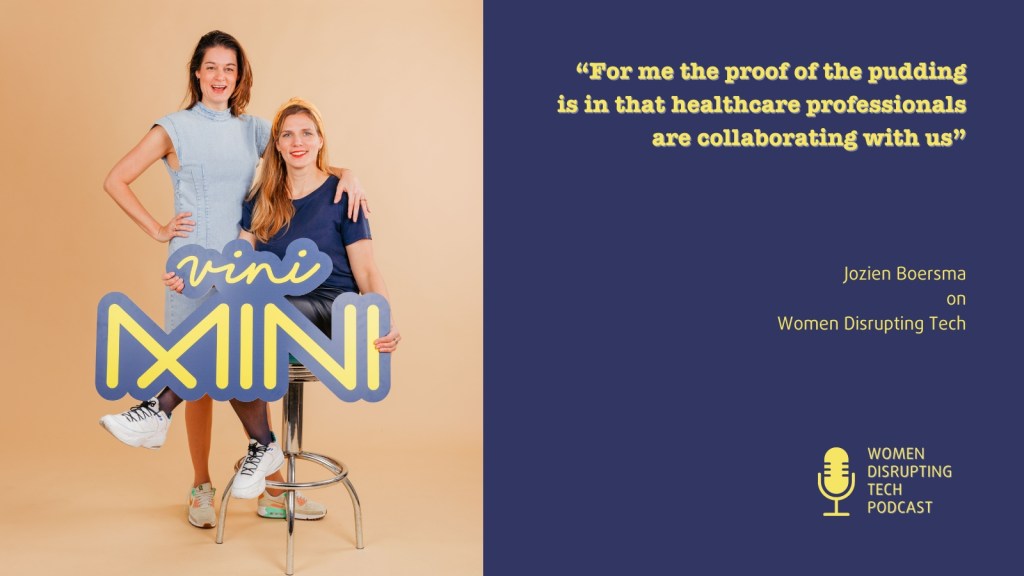
“For me, the proof of the pudding is that healthcare professionals are collaborating with us.”
Jozien Boersma, Co-founder Vini Mini
About Jozien Boersma
Jozien Boersma is on a mission to help parents prevent food allergies in babies. After getting an MBA from the Vrije Universiteit, she had a 15-year corporate career in marketing for nutrition companies like Danone and FrieslandCampina. She found her true calling as the co-founder of Vini Mini, where she empowers parents to prevent food allergies from the very start.
You can connect with Jozien on LinkedIn. If you have any questions about her work at Vini Mini, she invites you to email her.
About Vini Mini
In 2020, she co-founded Vini Mini with Laurie Lancee. Vini Mini helps parents to prevent food allergies in babies. They provide supplements that contain allergens like peanuts and nuts in doses that help the baby’s immune system build up resistance to them.
You can learn more about Vini Mini on their website, and I invite you to follow them on Instagram and LinkedIn.
Links to research
In this episode, Jozien highlights some research that is done into the effects of feeding babies the foods to prevent them from becoming allergic to them.
– The EAT study that was done in the UK to investigate the impact of early introduction of allergenic foods reduced the number of children developing food allergies and other allergic diseases, such as eczema.
– The LEAP study revealed that early introduction reduces the risk of peanut allergies by 80% compared to avoidance of peanuts.
– The PETIT Study investigated the effects of early introduction of egg to prevent egg allergy.
Let me know what you think!
Please let me know your thoughts about this episode of Women Disrupting Tech in the comments.
Feel free to share tips and tricks that you have on ensuring that your baby doesn’t develop a food allergy as well.
And if you would like to suggest a guest that I absolutely must have on the podcast, send me an email or a DM on LinkedIn.
What’s coming up?
Next week on Women Disrupting Tech, Kasia Pokrop will take us on a deep dive into the three Ms of a woman’s life: Menstruation, Motherhood, and Menopause.
After that, Mitra Gilasgar is my guest to discuss how she inspires the next generation of women in tech as a role model.
So stay tuned for more inspiring women disrupting tech and their male allies in season three of Women Disrupting Tech!
-
Interview with CXO Outlook

Recently, I was invited for an interview by CXO Outlook®. We talked about my mission and vision with Women Disrupting Tech, the benefits of Diversity, Equity and Inclusion in tech, and the role men can play in making tech more inclusive (so my podcast will be obsolete by the end of 2032). Click the logo below to read the full interview.
-
Redefining Palliative Caregiving with Pal CEO Nara Moripen | Show Notes to Episode 64 of Women Disrupting Tech

In this episode of Women Disrupting Tech, Nara shares how she transformed her personal journey as a caregiver into a digital platform that empowers family members to be active participants in their loved ones’ care.
She also highlights the often overlooked role of men in caregiving and explains how improving collaboration among caregivers is crucial for better outcomes.
To listen, click play below or find episode 64 of Women Disrupting Tech on your favorite podcast platform.
Redefining Palliative Caregiving with Pal CEO Nara Moripen | Episode 64 of Women Disrupting Tech – Women Disrupting Tech
The Magic You Can Expect in this Episode 🪄
Imagine coming home to spend a holiday with your family and being confronted with the news that your mother has a terminal illness.
This was the moment that set Nara Moripen on an unexpected journey into palliative care. It’s a journey she wasn’t fully prepared for, and one where the healthcare system could only offer limited support.
In episode 64 of Women Disrupting Tech, Nara and I discuss:
🤯 The challenges that family members face when providing palliative care
🪄 How her app, Pal, can help them tackle palliative caregiving challenges
🙋🏻♂️ The way to get men involved in caregiving.Taking it beyond Pal, Nara offers valuable insights into women in tech and the realities of fundraising, giving listeners an inspiring perspective on building a startup in the healthcare space.
Tune in now to hear Nara’s inspiring story and insights on how she is redefining palliative care with Pal. You can find episode 64 of Women Disrupting Tech on Spotify, Apple, and YouTube.
PS. Don’t forget to let me know your thoughts about the episode in the comments.
Free ways to support the Women Disrupting Tech
When you’re ready to support my guests in making this podcast obsolete by the end of 2032, help out by doing these two things:
- Use the share button to share the podcast with friends, family, and co-workers. This way, you give the women disrupting tech the platform they need to make it happen. Use the buttons below to share.
- Rate the podcast on your favorite podcast platform. Better yet, leave a review. You can use a rating of one to five stars. This will help other people discover the podcast. And if you leave a review, it will help me improve.
What makes this episode magical🌟?
Nara immediately dispels some common myths. Like the idea that palliative care is only for the last few weeks of someone’s life. And that getting reliable health information is easy. In fact, Nara openly admits to wasting a lot of time figuring out what to do or not feeling confident about what action to take while caring for her mother.
The idea for Pal started with her personal caregiving experience. And initially, Pal was designed for caregivers. But, as we discover during the podcast, healthcare providers and insurance companies may also benefit from the app.
When we discuss traditional role models and the role of men in caregiving, she highlights that she doesn’t think it is because men don’t want to or don’t have the time. Instead, it is because it’s difficult for different caregivers to collaborate effectively. And that is something that Pal solves for.

“I don’t think men are not caregivers because they don’t want to or don’t have time.”
Nara Moripen, Co-founder and CEO of Pal
About Nara Moripen and Pal
Nara Moripen is the co-founder and CEO of Pal. Before starting Pal, she worked as a strategy consultant in healthcare and life sciences. Nara holds a bachelor’s in International Business from Regent’s University in London and a Master’s in Management from EBS University for Economy and Law in Wiesbaden.
Nara loves to connect on LinkedIn. If you’re a healthcare professional or a caregiver and you’d like to learn more about contributing to Pal, feel free to email Nara directly.
Pal is a digital platform that supports millions of people who are caring for a loved one with a life-limiting illness. You can learn more about Pal’s journey in transforming palliative care via its website and on LinkedIn and Instagram. Its app is available in the App Store and Play Store.
Let me know what you think!
Please let me know your thoughts about this episode of Women Disrupting Tech in the comments.
Tell me your experiences with caregiving, tips and tricks that helped you, and if Nara inspired you to go on your own hero’s journey in tech.
And if you would like to suggest a guest that I absolutely must have on the podcast, send me an email or a DM on LinkedIn.
What’s coming up?
Next week on Women Disrupting Tech, Kasia Pokrop will take us on a deep dive into the three Ms of a woman’s life: Menstruation, Motherhood, and Menopause.
After that, we learn how we can prevent food allergies by feeding our newborns exactly the food that they could become allergic to.
So stay tuned for more inspiring women disrupting tech and their male allies in season three of Women Disrupting Tech!
More episodes like this?
If you like to listen to more episodes like this one, here are a few recommendations.
– In episode 4, Faviola Dadis describes a similar journey into health tech. She noticed the suboptimal treatments available to people with traumatic brain injuries. Her now-defunct startup, NeuroReality, tried to use the power of VR and gaming to improve outcomes.
– In episode 18, Lotte Leufkens shares her journey with Cloud Cuddle. Her story started as a project at TU Delft where she saw how much impact she could make with a foldable bed for children with physical and mental challenges.
In episode 56, Jacqueline Kazmaier explains how Autoscriber harnesses the power of AI to improve the lives of doctors and patients. Her journey started in a hospital, where she noticed how much time doctors spent on administrative tasks.Seach for other blogposts and episodes
By topic:
Alice Pavin Andrea Christancho Angel Investing Artificial Intelligence Carolina Bongers community Cybersecurity Diversity in Tech DNNL Dorit Roest Dutch episode ecosystem Education Exited Founder Female Founder Fintech Food Funding Funding of female founders Gaming government funding Grace Hopper Healthcare HR Impact Inclusion lessons learned male ally Marketing Podcast Practical takeaways for founders Role It Out role model show notes Simone Mink Solo Episode Sophia Zitman Sustainability Travel Valerie Hirschhauser Venture Capital Women Disrupting Tech Women Disrupting Tech Events Women in Tech Women Who Built The Internet
By date:
- March 2026
- February 2026
- January 2026
- December 2025
- November 2025
- October 2025
- September 2025
- August 2025
- July 2025
- June 2025
- May 2025
- April 2025
- March 2025
- February 2025
- January 2025
- December 2024
- November 2024
- October 2024
- September 2024
- August 2024
- July 2024
- June 2024
- May 2024
- April 2024
- March 2024
- February 2024
- January 2024
- December 2023
- November 2023
- October 2023
- September 2023
- August 2023
- July 2023
- June 2023
- May 2023
- April 2023
- March 2023
- January 2023
- December 2022
- November 2022
- October 2022
- September 2022
-
Women Who Built The Internet: Radia Perlman

Vint Cerf is often regarded as the ‘father of the Internet.’ But did you know that the Internet has a mother, too?
Let me tell you about Radia Perlman. Without her Spanning Tree Protocol (STP), the Internet would be a whole lot buggier and slower.
Scroll down to read her story.

AI-generated image of Radia Perlman while working on her Spanning Tree Protocol. About Radia Perlman
Radia Perlman was born in Portsmouth, Virginia, in 1951. Growing up, she had no problems with math and science. This is not strange considering that both her parents worked as engineers: her father worked on radar, and her mother worked as a computer programmer.
However, it took a programming class in high school to get her interested in computers. From there, things developed quickly and positively: during her bachelor’s at MIT, she developed a child-friendly version of the programming language LOGO that allowed children as young as 3 years old to program their own robots.
Her contribution to the Internet
Radia Perlman is best known for her invention of the Spanning Tree Protocol (STP) while working for Digital Equipment Corporation in 1985.
STP allows a network to deliver data reliably by making it possible to design the network with redundant links. This setup provides automatic backup paths if an active link fails and turns off the links that are not part of the tree. This leaves a single, active path between any pair of network nodes.
More recently, she invented the TRILL protocol to correct some of the shortcomings of spanning trees, allowing Ethernet to make optimal use of bandwidth.
Before STP, only computers that belonged to the same network could communicate with each other. Radia’s “magic box” made it possible to communicate between networks as well. In that sense, it is a backbone for a reliable and functioning internet.
Inventing it was kind of a funny story
She invented it, literally, on a Friday and spent the next Monday and Tuesday documenting it. Then, she spent the rest of the week writing a poem about her ‘tree,’ which she called an “Algorhyme.”
Implementation turned out to be so simple that engineers would not need to ask a single question.

Picture of Radia Perlman with one of her quotes about diversity. Picture by Scientist-100 at English Wikipedia “The kind of diversity that I thing really matters isn’t skin shade or body shape but different ways of thinking.” – Radia Perlman
But wait, there’s more…
Like Marian Croak, Radia Perlman has more than 200 patents in her name. About 40 stem from her time at Sun Microsystems in the late 1990s.
Beyond STP and TRILL, Perlman has contributed significantly to network security. She has worked on innovative concepts in cryptography and network robustness, influencing the development of secure communication protocols.
Her work on the design of security systems helped lay the foundation for the safe exchange of data on the Internet.
So, the next time you wonder how you can surf the web without errors, thank Radia Perlman.
What’s with the quote?
Radia Perlman has spoken openly about the lack of diversity in tech and the importance of creating more inclusive environments. Despite her groundbreaking contributions, she often encountered subtle biases and societal expectations that made it harder for women to be taken seriously in technical roles.
She has also often highlighted that diversity isn’t just a matter of fairness. According to her it is crucial for innovation. Diverse teams bring different perspectives, which can lead to better problem-solving and more creative solutions.
She has argued that the tech industry misses out on great ideas and talent when it lacks diversity, reinforcing the notion that inclusivity is essential for technological progress.
Her legacy
In addition to the 200+ patents, there are many children’s books and about 20 books on various STEM-related topics. Perlman has also taught courses at the University of Washington, Harvard University, MIT, and Texas A&M and has been the keynote speaker at events all over the world.
She was elected a member of the National Academy of Engineering in 2019 for contributions to Internet routing and bridging protocols. She was inducted into the Internet Hall of Fame in 2014 and into the National Inventors Hall of Fame in 2016.
She also received lifetime achievement awards from USENIX in 2006 and from the Association for Computing Machinery’s SIGCOMM in 2010.
As of 2022, she was a Fellow at Dell Technologies.

Women Disrupting Tech | The Podcast
The Podcast Closing the Funding Gap for Women in Tech.
 Women Disrupting Tech | The Podcast