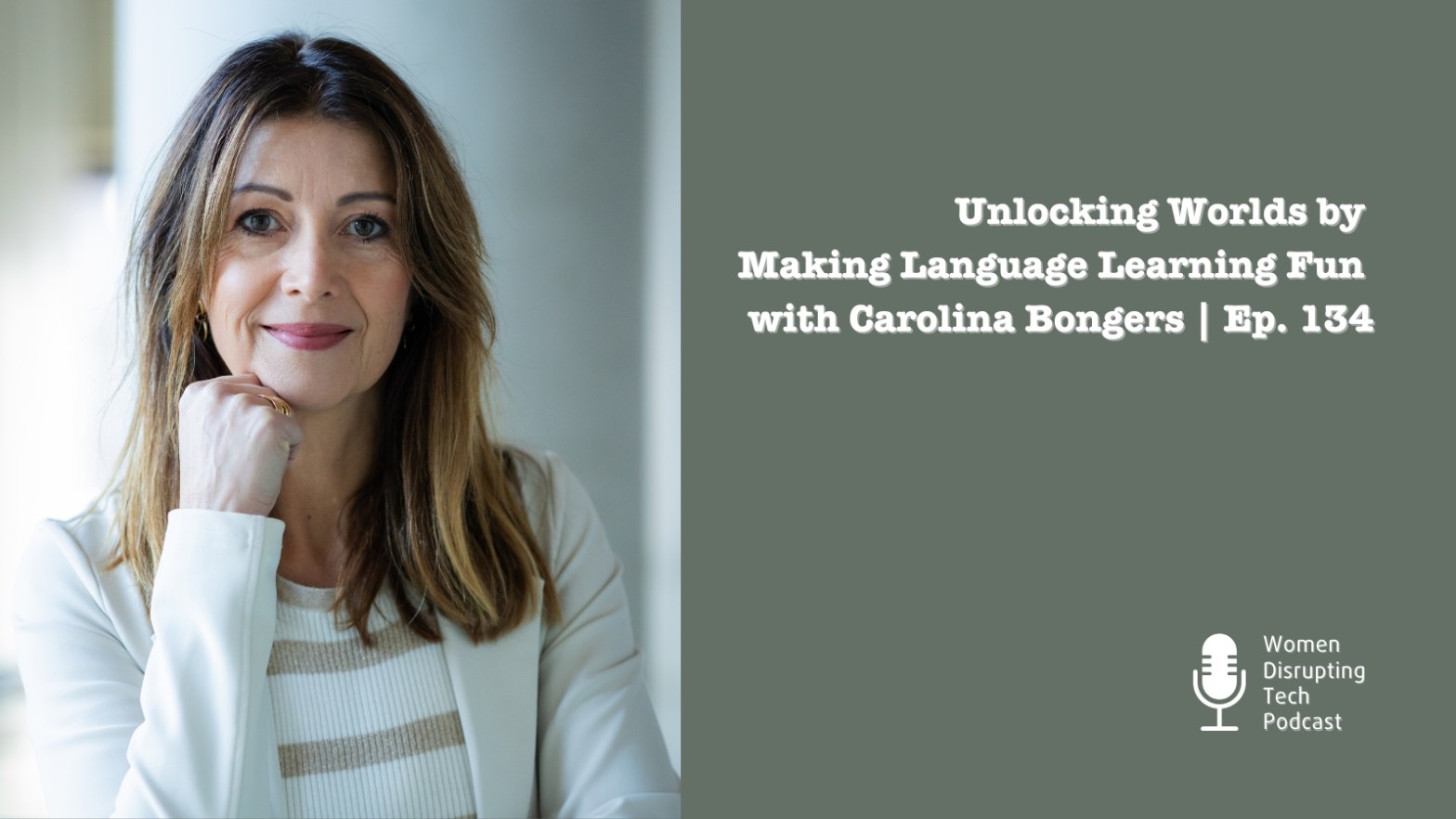
What if teaching young children a language is less about teaching words and more about opening doors to entire worlds?
Carolina Bongers knows this firsthand. Being raised bilingual gave her a brain wired for optimism and problem-solving. When her own children were young, she wanted to give them that same advantage. But the methods she found were boring, uninspiring, and built for adults who could already read and write.
So she built Jungle the Bungle—a language learning app for children aged two to eight where learning feels like play.
In this episode, you’ll hear why she started validating her idea by writing a book, why she believes that parents should offer their children responsible, high-quality content, and how her Disney background shapes how she thinks about storytelling, characters, and scale.
Hit play to listen to the episode on Spotify, Apple Podcasts, or YouTube, or scroll down to read about the other lessons for startup founders, women in tech, and their allies.
3 Lessons From This Conversation
What makes this conversation work is how clearly Carolina’s thinking shows up in her product decisions. Nothing feels accidental. Each choice follows logically from how she looks at children, learning, and opportunity.
Fun is the engine, not the reward
Carolina was very clear about this. If children don’t enjoy something, they simply won’t use it. And if they don’t use it, learning never really starts. That belief runs through Jungle the Bungle. Children are never told they are wrong. The app quietly adapts the level in the background, so curiosity stays intact and frustration never takes over. Learning happens because children keep playing, not because they are corrected.
Validation does not have to start with technology
Before building an app, Carolina wrote children’s books to bring the characters to life and see how children and parents responded. That approach stood out to me because it feels obvious in hindsight, yet it’s rarely done. She tested the emotional core of the idea first. Only once she saw that children connected with the characters did she invest in building the digital product around them.
Real demand does not always come from where you expect it
Jungle the Bungle was designed for parents, but schools and teachers became the strongest early adopters. They use the app mostly to support children learning Dutch in the classroom without requiring constant supervision. That forced Carolina to rethink assumptions about her audience and adapt the product for classrooms. Instead of resisting that shift, she followed the signal. The product became stronger because she listened.
These lessons matter because they show how good products are built by paying attention to real behavior, not by sticking rigidly to the plan you started with.
💬 Know someone building something for children, learning, or education who could benefit from these lessons? Share this episode with them.
Or scroll down for magical moments, practical takeaways, and my own observations.
And if you want more lessons like this? Subscribe to updates for a weekly dose of female founder inspiration.
- 3 Lessons From This Conversation
- Highlights and timestamps
- 3 Magic Moments In The Episode
- Practical Takeaways for Founders
- The Quote From The Episode
- 3 Things That Changed The Way I Think
- A Question for You 🤔
- Coming up on Women Disrupting Tech
- Listen to Episode 134 on Spotify, Apple, or YouTube
- About Carolina Bongers
- About Mendix
- Other ways to amplify the voices of Women Disrupting Tech
- Events that Women Disrupting Tech Must-Attend
- What I Want To Leave You With
Highlights and timestamps
| Time | Highlight |
|---|---|
| 02:05 | Introduction to Jungle de Bungle |
| 04:47 | The Power of Bilingualism |
| 07:36 | Creating Engaging Educational Content |
| 09:58 | Addressing Screen Time Concerns |
| 12:36 | Fun and Effective Learning Methods |
| 15:39 | Transitioning from Books to Apps |
| 18:25 | Adapting for Schools and Educational Needs |
| 21:06 | Future Growth and Expansion Plans |
| 23:46 | Crowdfunding and Community Engagement |
| 26:42 | Lessons Learned and Overcoming Challenges |
| 29:40 | Vision for the Future of Jungle de Bungle |
3 Magic Moments In The Episode
Carolina’s background at Disney kept surfacing throughout this conversation. Not as name-dropping, but as a way of thinking. About characters. About emotion. And about how stories shape behavior long before logic ever does.
“We’re not teaching words, we’re unlocking worlds.”
This moment landed because it reframed everything. Carolina is not building a vocabulary tool. She is trying to give children access to the same cognitive and emotional advantages she experienced growing up bilingual. Language becomes a way to open doors, not a goal in itself. Once she said this, the rest of her choices made more sense.
Removing right and wrong from learning
Another moment that stayed with me was how deliberately the app avoids telling children they are wrong. If a child makes a mistake, the app quietly adjusts the level in the background. There is no failure signal. Just another chance to keep going. It’s a small design choice with a big impact. Children stay curious. They keep playing. And learning happens without pressure.
The magic of characters and the dreamer’s motto
When Carolina talked about briefing the illustrator, her Disney roots became very tangible. The instruction was simple: a child should see the character and fall in love instantly. That belief in the power of characters is paired with her favorite Disney motto: if you can dream it, you can do it. It explains why she talks about movies, events, and even theme parks without irony. She is building something playful, but she is thinking very big.
These moments matter because they show how ambition, empathy, and craft can coexist. They explain why Jungle the Bungle feels intentional rather than accidental.
💬 What was your favorite moment from the episode? Share yours in the comments.
Or scroll down for practical tips that will fuel your own journey as a founder.
Practical Takeaways for Founders
Many founders end up building not just an app, but an ecosystem. Carolina is no exception, but her journey started in an unusual way: by writing a book. It helped her test whether children connected with the characters and whether parents believed in the idea of early language learning. From there, she started building and learned valuable founder lessons along the way.
Crowdfunding as community building
Crowdfunding was not just a way to raise money. It became a way to build a group of people who genuinely cared about the company’s success. Carolina now has more than a hundred investors who act as ambassadors, talk about the product, and stay involved. That kind of early support creates momentum you can’t buy later.
Reframing the act of asking for money
Carolina was open about how awkward fundraising felt in the beginning. Asking people for money never feels natural at first. What changed everything was her mindset. Once she stopped seeing it as begging and started seeing it as inviting people to be part of a success, selling became easier. Confidence followed clarity about the value she was offering.
Pick your battles for perfection
Coming from companies like Disney and L’Oréal, Carolina had very high standards. Startup life forced her to be selective. Some things still need to be perfect, like emails to customers or key brand moments. Other things, like early versions of the product, need room to evolve. Knowing where to hold the line and where to let go is not lowering standards. It’s how progress happens.
These takeaways matter because most founders struggle with validation, funding, and perfection at the same time. Carolina’s approach shows that tackling them one by one makes the journey feel more manageable.
💬 Know a founder who’s navigating these exact questions? Use the share button below to send them this episode.
Or scroll down to discover an inspiring quote and learn about my own takeaways.
The Quote From The Episode
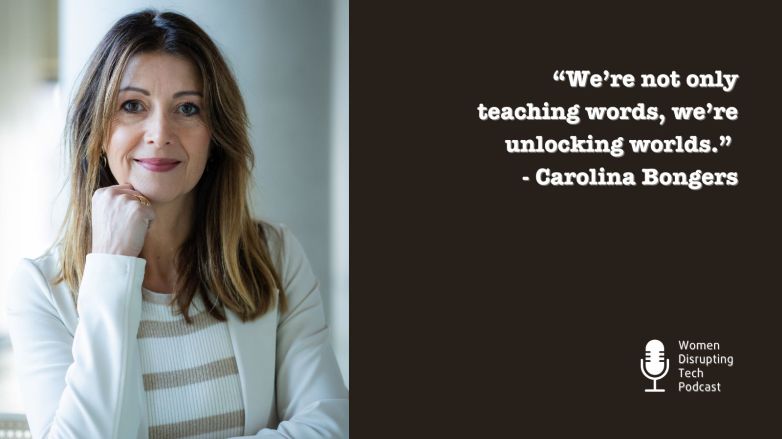
“We’re not teaching words, we’re unlocking worlds.”
Carolina Bongers, co-founder Jungle the Bungle
This line captures the heart of Carolina’s story because it reflects how she thinks about impact. Teaching words is not the point. Creating access and possibility is. For children who are not raised bilingual, learning a new language can open up confidence, curiosity, and a sense of possibility that reaches far beyond vocabulary.
3 Things That Changed The Way I Think
This conversation pushed me to question a few of my own assumptions about launching a product and building a company. Not in a dramatic, but in a practical way.
Parents are often the easier entry market, but not always always.
In edtech, the common logic is that parents are the least complex market to start with. Fewer stakeholders. Faster decisions. Carolina’s experience complicates that picture. Jungle the Bungle found real traction with schools and libraries early on, because teachers saw the impact on children who needed language support most. It reminded me that “easier” is not always the same as “right,” and that early demand deserves to be taken seriously, even when it shows up somewhere else than expected.
Validation can be analog.
I don’t know many founders who validate part of their idea by writing a book. Carolina did exactly that. And the more I thought about it, the more it expanded my own view on validation. She didn’t start by testing features or funnels. She tested whether children connected with the characters and whether parents believed in the idea. That kind of proof is not digital, but it is very real. It made me rethink how narrow our definition of validation sometimes is.
Perfection is contextual.
Coming from companies like Disney and L’Oréal, Carolina was used to very high standards. Startup life forced her to recalibrate. Some things still need to be flawless. Others need space to evolve. That tension felt very familiar to me. Letting go of perfection is not about lowering the bar. It’s about deciding consciously where the bar actually needs to be at each stage.
These shifts matter because they influence how I look at markets, proof, and progress as a founder myself.
💬 What changed your thinking reading or listening? Let me know your thoughts in the comments.
A Question for You 🤔
💬 Do you think children should learn second languages early on in their lives?
👇 Share your thoughts in the comments. Let’s keep this conversation going and discover new truths.
Coming up on Women Disrupting Tech
Next week, I sit down with Valerie Hirschhauser to explore how hustle becomes normalized, why intuition deserves a place in leadership decisions, and how small shifts in how you structure your days can change everything.
In this clip from the episode, Valerie shares her vision of future boardrooms where intuition carries the same weight as data, and where women no longer have to toughen up to be taken seriously.
Want to hear the rest? When you’re subscribed, you’ll find it in your mailbox on 15 January 2026 at 8 am CET. So stay tuned for more Women Disrupting Tech.
And until the next episode, as always, keep being awesome.
Dirkjan
PS. You’ve come this far? You must be a fan. So do yourself a favor and subscribe to updates:
Or follow the show on Spotify, Apple Podcasts or YouTube.
Listen to Episode 134 on Spotify, Apple, or YouTube

Unlocking Worlds by Making Language Learning Fun with Carolina Bongers | Ep. 134 – Women Disrupting Tech

About Carolina Bongers
Carolina Bongers is the founder of Jungle the Bungle, a language learning platform for young children built on the belief that early multilingual education should be joyful, not tedious. She grew up bilingual with a Spanish mother and Dutch father, and that experience shaped her appreciation for the lifelong advantages of speaking more than one language. After careers in brand roles at companies like Disney and L’Oréal, she saw a gap in tools that help very young children learn languages in a way that feels natural and fun. Her drive to fill that gap began with writing multilingual children’s books to test whether kids connected with her characters and stories, and eventually led to building the Jungle the Bungle app with a focus on playful learning and real educational impact.
You can connect with Carolina on LinkedIn.
About Mendix
Jungle the Bungle is a playful language learning platform designed for children aged two to eight, where learning happens through exploration, stories, songs, and games rather than drills or repetition. The idea originated in 2015 when founder Carolina Bongers saw that existing tools did not make language learning engaging for very young kids. Before the app existed, the Jungle the Bungle universe was tested through multilingual children’s books that sold thousands of copies, validating both the characters and the concept.
The interactive app builds on that foundation with smart, adaptive learning and a world of colorful characters that invite children to discover English, Dutch, Spanish, and more in context. Teachers and schools have embraced the platform for its ability to motivate learners and make vocabulary acquisition feel like play, and the company’s mission extends beyond entertainment to expand access to early language skills for as many children as possible.
You can check out the app in the Apple App Store or the Google Play Store. And you can learn more about Jungle the Bungle on the website and by following Jungle the Bungle on LinkedIn, Facebook, and Instagram.
Other ways to amplify the voices of Women Disrupting Tech
Want to make inclusion in tech the new normal by 2032? Here’s how you can help:
Follow the Women Disrupting Tech Podcast
Follow the podcast on your favorite platform. Every follow brings these stories to more people.
Give the show a rating or review on Spotify or Apple.
It only takes a moment, but it tells others this podcast is worth listening to. And helps the voices of my guests carry further.
Share the stories that move you.
Send this episode to a friend, a colleague, or someone who needs to hear it. Every share helps to build a more inclusive tech future and supports my guests in getting the stage they deserve.
So when you know someone who should hear it, pass it on when you’re done.
Events that Women Disrupting Tech Must-Attend
The fall is loaded with great events, and I’ve found some cool ones. Below is one event you definitely want to check out. For a full overview of all events, including links to buy tickets, please check the events page.
Featured Event: That’s What She Said
Looking for an event to start your new year off right? Well, Impowr and Boom Chicago have got your back. They’re starting on 14 January 2026 (that is next Tuesday) with an event where networking meets comedy. You can get your early-bird ticket (a €10 discount until 30 November) on the Boom Chicago website.
This is the last week you can get that early bird, and the last time I spoke with the ladies of Impowr, they had sold 70 tickets already.
Diverse Leaders in Tech Events
If you like being in the know about what is happening in the DEI space, Diverse Leaders in Tech is the place to be.
Every last Thursday of the month, they have monthly in-person meetups for tech people, HR leaders and supporters of diversity to exchange insights, tackle challenges, and take action. It’s a vibrant, safe space where diversity is celebrated.
You can register for events on the DLiT website. Did I mention that joining your first event is free?
Equals Events
Equals is on a mission to shape a society where women and men stand on equal footing. At their home base in Amsterdam, they regularly organize events, but you can organize yours there too. You can find the events on Luma.
What I Want To Leave You With
What I appreciated most about this conversation is how quietly ambitious Carolina is. She’s building not just a language learning app but an omnichannel franchise that successfully bridges the gap between entertainment and education.
By combining the storytelling magic she learned at Disney with evidence-based didactic methods, Carolina built a tool that meets a real need in schools and homes alike. Her path from a bilingual upbringing to a startup aiming for “world domination” serves as a testament to the power of starting small, validating early, and never losing sight of the “magic” that captures a child’s imagination.
If there’s one thread running through this episode, it’s that learning, like building a company, works best when curiosity stays intact. When pressure is removed. And when space is created to grow at your own pace.
You can find the episode on Spotify, Apple Podcasts, or YouTube.

 Women Disrupting Tech | The Podcast