

Many inventions related to the Internet have been attributed to men. However, some of the key technologies that the Internet is built on actually originated from women’s inventions.
Like the word processor. The word processor is now one of the most used applications on any computer. It makes the lives of writers, journalists, bloggers, and secretaries a lot easier.
But we would all still be using a typewriter if Evelyn Berezin, a female founder of a tech startup, had not invented the Data Secretary in 1969.
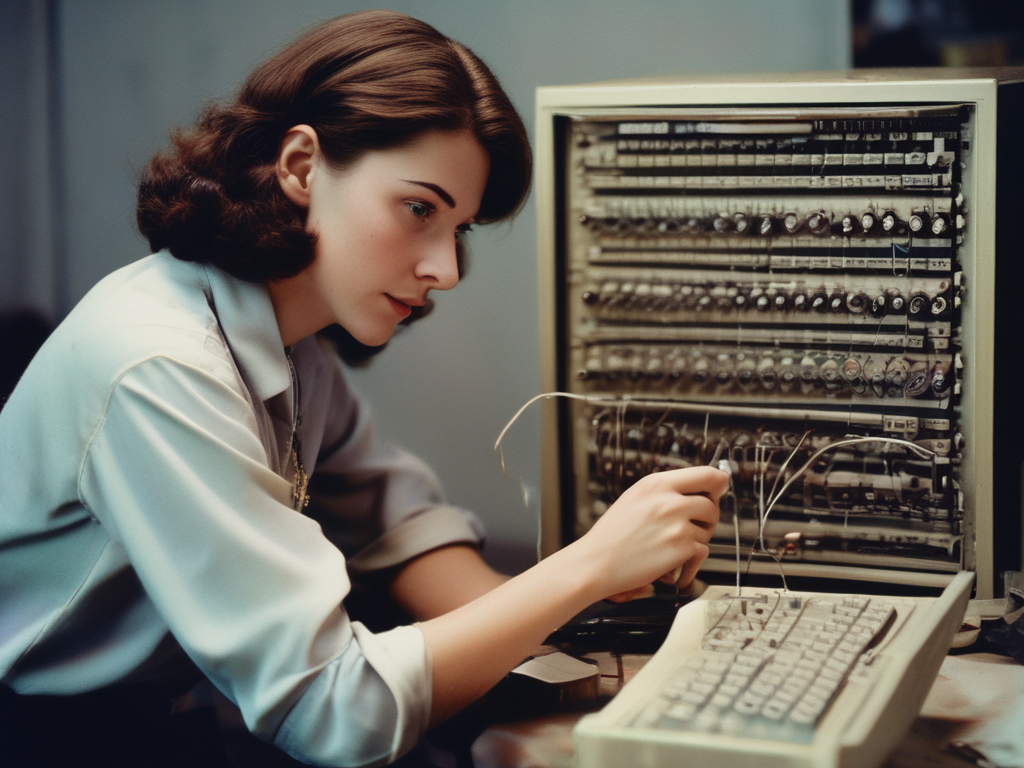
About Evelyn Berezin
Evelyn Berezin was born in 1925 in New York. She was the daughter of Russian immigrants. During her youth, she got very interested in mathematics and science, which led her to earn a degree in physics from New York University.
From 1951 to 1969, Berezin worked for several computer startup companies, learning logic design and other systems. Challenging societal norms and barriers, she was often the first or only woman technologist at these companies.
From 1957 to 1961, she worked for Teleregister, Inc. on the development of the world’s first airline reservation system.
Berezin felt that, as a woman, she could not become a senior manager at an established computer company, so she started her own, Redactron Corporation. With that, she became a female founder avant-la-lettre.
“At that time the idea that a person who was a manager might give up his secretary because he could do it himself did not exist. The men did not want to buy those machines because they were afraid they would lose their secretary, which would mean some diminution of status for them.” – Evelyn Berezin
Her contribution to the Internet
Evelyn Berezin is best known for inventing the word processor. The machine was called Data Secretary. She did so in 1969, a time when computers were in their infancy.
The initial model was the size of a small refrigerator and had no screen. Later versions of Redactron came with monitor screens for text, smaller consoles, and more programmed features to smoothen the writing and editing tasks.
Even though the technology was groundbreaking and the business case was clear, selling the machine turned out to be challenging. As she recalls, “At that time, the idea that a person who was a manager might give up his secretary because he could do it himself did not exist. The men did not want to buy those machines because they were afraid they would lose their secretary, which would mean some diminution of status for them.”
What goes up…
The Data Secretary was good business for quite a while. Her company was the only one that manufactured and sold these revolutionary machines for $8,000 a piece. Her clients were mostly law firms and corporate offices. By 1974, her company already had a revenue of $16,2 million per year.
However, staggering inflation and high interest rates ultimately forced her to sell her company to the Burroughs Corporation in 1976. She stayed on until 1979.
From 1980 to 1987, she was a General Partner at Greenhouse, a venture capital group dedicated to early-stage high-technology companies.
A lasting legacy
Evelyn Berezin’s work laid the foundation for modern word processing and had a lasting impact on the evolution of computer technology. She was an extraordinary female pioneer during the first three decades of an overwhelmingly male computer industry
As the New York Times pointed out in her obituary, Evelyn Berezin “liberated secretaries from the shackles of the typewriter” with her invention.
As one of the first electronic word processors aimed at simplifying secretarial work, the Data Secretary helped open up new career growth opportunities for women in business and technology.
And, without her, as Gwyn Headley aptly put it, “there would be no Bill Gates, no Steve Jobs, no internet, no word processors, no spreadsheets; nothing that remotely connects business with the 21st century.”
She was inducted into the National Inventors Hall of Fame in 2022, and her legacy as a trailblazing female entrepreneur in a male-dominated field continues to inspire future generations of women in tech.

 Women Disrupting Tech | The Podcast